Bitcoin Just Hit Its Lowest Price in 21 Months. Here’s Exactly What Went Wrong — and What Comes Next

It’s been a brutal week for Bitcoin holders.
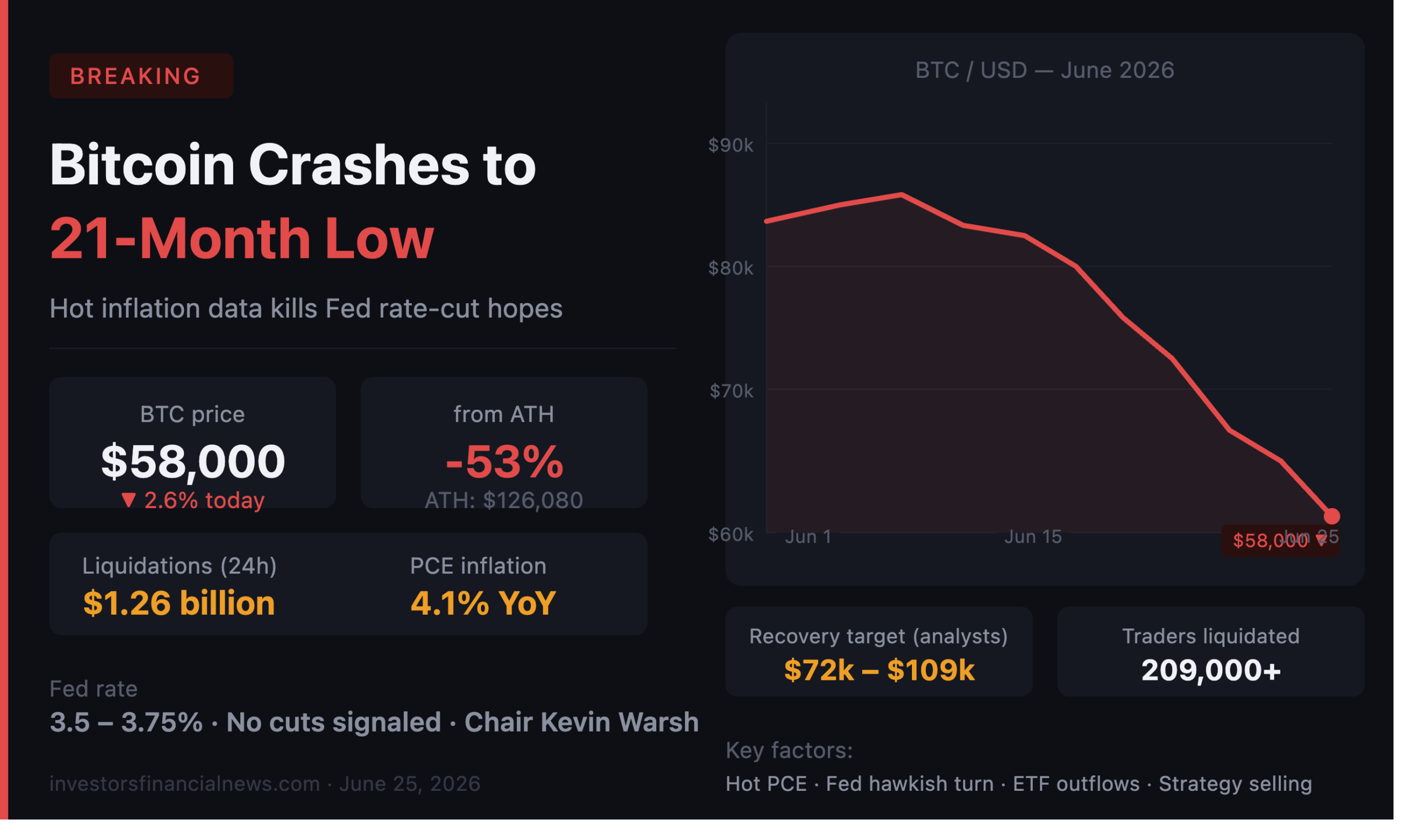
On Thursday, BTC crashed to $58,000 — its weakest level since September 2024 — after the Federal Reserve’s preferred inflation gauge came in hotter than markets expected and torched any remaining hopes of rate cuts in 2026. Over $460 million in leveraged long positions were liquidated in a single hour. Total crypto liquidations across the market hit $1.26 billion in 24 hours, wiping out more than 209,000 traders in one session.
For context: Bitcoin hit an all-time high of $126,080 just eight months ago in October 2025. It has now fallen more than 53% from that peak.
So what happened? And more importantly — is this the floor, or is there more pain ahead?
The Inflation Report That Broke the Market
The catalyst was Wednesday’s PCE data — the Personal Consumption Expenditures index, which is the Federal Reserve’s preferred measure of inflation.
The numbers were bad.
The PCE price index rose 4.1% year-on-year in May — its highest reading since April 2023 — while core PCE came in at 3.4%. Both figures came in well above what markets had hoped for, and the message was clear: inflation is not under control, and the Fed is not cutting rates anytime soon.
Bitcoin had been trading above $61,800 earlier in the session. After the PCE print dropped, the selling accelerated fast. BTC dropped nearly 2.6% within hours, triggering a wave of forced selling as leveraged longs got wiped out.
The Nasdaq 100 reversed its gains in the same window. Both markets told the same story: when inflation is running hot, risk assets get punished.
The Fed Under Kevin Warsh: No Cuts, No Mercy
The inflation data didn’t arrive in a vacuum. It followed what may have been the most hawkish Fed meeting in years.
At his first meeting as Fed Chair on June 17, Kevin Warsh held the benchmark rate at 3.5%–3.75% but adopted a dramatically more hawkish stance — removing language that suggested future rate cuts, raising the Fed’s 2026 inflation forecast from 2.7% to 3.6%, and, notably, eliminating forward guidance from the Fed’s statement entirely.
That last move is significant. Forward guidance removal means the Fed is no longer telegraphing its next move. Markets can’t price in a pivot they can’t see coming.
Markets responded by pricing in a higher probability of rate hikes, pushing the dollar and real yields higher — both of which put direct pressure on Bitcoin.
Under Warsh, the Fed held rates at 3.5% to 3.75% in June and projected higher rates ahead, tying part of the price pressure to energy supply shocks from the ongoing Middle East conflict. With oil prices elevated and inflation sticky, the Fed’s hands are tied — and crypto is paying the price.
What’s Actually Killing Bitcoin Right Now
This isn’t just a Fed story. Several forces hit simultaneously, and understanding each one matters for figuring out when this reverses.
1. Inflation Killed the Rate Cut Trade
Bitcoin thrived in 2024 and 2025 partly because markets expected the Fed to cut rates. Lower rates mean cheaper money, more liquidity, and capital flowing into risk assets. With inflation clocking in far above the Fed’s 2% target, any remaining expectations for accommodative monetary policy in 2026 evaporated almost instantly. Bitcoin’s bull case got a key leg knocked out from under it.
2. Institutional Money Is Leaving
U.S. spot Bitcoin ETFs saw about $1 billion in net outflows in a single week, extending what analysts described as a record streak of withdrawals. When the institutions that drove BTC’s surge to $126,000 start heading for the exits, retail doesn’t have the firepower to absorb the selling.
3. Strategy Blinked
Strategy — formerly MicroStrategy, and the corporate entity most closely associated with Bitcoin accumulation — executed its first Bitcoin sale since 2022. When the most publicly bullish corporate Bitcoin holder in the world starts selling, the signal it sends to the rest of the market is impossible to ignore.
4. AI Stocks Are Stealing the Show
Analysts at Presto Research say Bitcoin’s slump reflects competition from gold and AI stocks, as investors reassess Federal Reserve rate-cut prospects. Capital that might have flowed into crypto is instead chasing Micron, Nvidia, and the AI infrastructure trade — which, unlike Bitcoin, is generating record earnings and revenue right now.
Is $58,000 the Floor?
This is the question every crypto investor is asking — and the honest answer is: maybe, but not certainly.
The case for a floor here is real. Several indicators — including mining rig shutdown prices, market sentiment, and the RSI — suggest Bitcoin is in an oversold state and flashing bullish signals. When miners start losing money on every block they mine, it historically marks a zone where further downside becomes limited. Production cost support at $60,000 is a meaningful technical level.
But the macro environment could override all of that. Whether $58,000 marks a floor may hinge on the Fed’s next meeting in late July. With inflation rising and growth steady, policymakers have little reason to cut — leaving risk assets exposed to further swings.
Bitcoin recently declined below its quarterly open at $68,266 and could continue to compress within the $60,000-to-$70,000 range without a new catalyst for volatility. A hike rather than a cut looks increasingly plausible at the September FOMC meeting if inflation doesn’t cool meaningfully.
The Recovery Case — And What It Requires
Despite the pain, the longer-term recovery case for Bitcoin hasn’t collapsed. It’s just been pushed further down the calendar.
Several major crypto analysts still expect Bitcoin to trade between $72,000 and $109,000 before the end of 2026 — but they note a recovery will likely require stronger institutional demand, fresh ETF inflows, and better economic conditions.
The path there runs directly through the Fed. If inflation cools in the July and August data, a September rate hold (instead of a hike) could provide relief. If the Fed actually signals a cut later in the year, expect a sharp reversal. Without large capital support from institutions, price recovery may take longer than expected.
Here’s what to watch:
July PCE and CPI prints — If inflation starts cooling, the rate hike narrative weakens and risk appetite returns.
July 29 FOMC meeting — The next Fed decision. Any softening in tone from Warsh could light a short-term fire under crypto.
Bitcoin ETF flows — A reversal from outflows to inflows would signal that institutional money is returning. Watch Coinglass weekly.
$60,000 as technical support — This level has become both psychological and structural. A clean break below it on heavy volume would signal more pain ahead. A hold above it gives the bulls something to build on.
The Bottom Line
Bitcoin is in a macro-driven bear phase, and the trigger is simple: inflation is running too hot for the Fed to cut, and risk assets are suffering for it. The same formula that drove BTC from $40,000 to $126,000 — cheap money, institutional adoption, and rate cut optimism — has run in reverse.
That doesn’t mean the story is over. Bitcoin has survived worse. But the next leg up requires either the Fed to blink, inflation to cool, or institutional buyers to return in force.
Until one of those three things happens, volatility is the only guarantee.
If you’re holding, know why you’re holding. If you’re watching from the sidelines, know what you’re waiting for. Either way — the next few months are going to be worth paying attention to.
This article is for informational purposes only and does not constitute financial advice. Cryptocurrency investments carry significant risk. Always consult a licensed financial advisor before making investment decisions.
Tags: Bitcoin, BTC price, crypto crash, Federal Reserve, inflation, PCE, rate cuts, Kevin Warsh, crypto liquidations, Bitcoin ETF, crypto investing, Bitcoin 2026